STAGE 1: DECIDING IF PUBLIC ENGAGEMENT IS WHAT YOU WANT TO DO
How to embed engagement
into decision making
This guide explains how to make sure the engagement process and the recommendations
that come from it are an essential part of any decision-making process.
Decision making includes any decision about changes in policy, practices,
or other outcomes that can be influenced by the public’s input.
The public can make valuable suggestions that will directly affect the decisions being made.

Why?
It can lead to real changes, like prioritising funding for home retrofitting or deciding not to charge for cycle training. For any of these changes to happen, the institution needs to be open to the idea and prepare for it before the engagement begins.
The engagement process should be driven by decision making. Recommendations and feedback from the public should inform key decisions at every stage. To make sure these insights have an impact, the engagement should happen early enough in the decision-making process to shape the final outcome.
The benefits of public engagement in decision making
Shift power to people on the issues that affect their lives
Effective engagement ensures that decisions are rooted in the views and values of the public. This helps to create public services responsive to people’s needs and makes the most of their strengths. It ensures that decision-making power is more evenly distributed throughout society.
Bring people together to solve our most complex and challenging issues
Involving the public is often the best – and only – way to overcome political stalemate and solve the most controversial and challenging topics. Leveraging the power and insights of ordinary people helps improve difficult decisions, decide on trade-offs, and organise collective action to address the complex challenges that we face.
Help people find common ground with others and end polarisation
Dialogue is essential for bridging divides between communities and building a strong, cohesive and prosperous society. When people are given the opportunity to work together on a shared task, they build understanding and trust and often find they agree on many more things than they disagree.
Make more appropriate decisions
More accurate and representative information about the needs, priorities and capabilities of local people, including better feedback on existing programmes.
Increase legitimacy and support for decisions
Engagement can allow support for a decision to be developed with partners and participants before it is formally taken, so increasing the legitimacy of the decision through public support. Note however that participants are often quick to withdraw from projects if they feel that promises have not been delivered.
Increase accountability to the public
Engagement can build on the formal systems of accountability in local authorities by enabling citizens to hold elected representatives, and others, more directly accountable through face-to-face discussions.
Improve inclusion and cohesion
Carefully designed and implemented engagement can create mechanisms and institutions that can enable marginalised groups to be brought into the decision-making process. People who are excluded from decision-making may well have relevant new information or knowledge to contribute to a decision.
Meet the public demand and expectations for involvement
Most institutions have long recognised the need to meet public demand for involvement.
Planning and implementing public engagement
in decision making
Gaining institutional buy-in
Clarifying the process for gaining the institutional buy-in is vitally important because:
- It establishes a commitment to change from the start by recognising that some response will need to be made;
- It ensures that mechanisms are in place to deal with the outputs that come from the engagement process and ensures that these outputs can be dealt with effectively and within a given timescale;
- It allows those running the process to explain to participants exactly what will be done with their effort, how the process will be managed and how its outcomes will change things;
- It helps clarify what is and is not discussed (there is no point discussing things that really cannot be changed);
- It helps explain the roles of the different participants, as it clarifies what is expected of them all at different stages of the process.
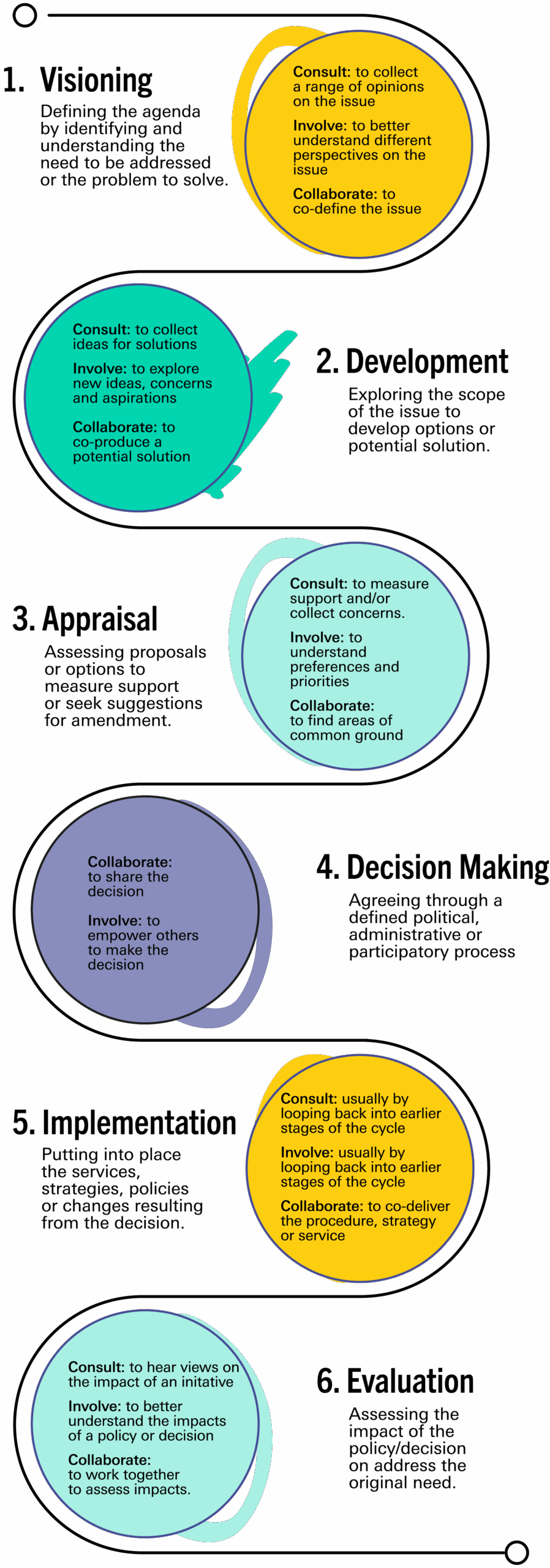
Common challenges
• Decision makers don’t always prioritise how to include engagement recommendations, often due to other urgent issues. Early involvement of decision makers is important so they understand the issues from the start and can respond quickly and effectively later on.
• Being unclear about the difference between engagement and consultation which results in confusion about what sort of institutional response is required and expected.
• Wider political tensions, including issues of:
• Accountability: Is the decision making process legitimate?
• Leadership: how does the process fit with conventional political leadership?
• Democracy: how does the process relate to the role of elected representatives?
• Inability / unwillingness to do what the engagement has recommended. It may not always be possible for all the conclusions of an engagement process to be acted upon immediately (or ever, in some cases).
If it is likely that it will prove impossible for an institution to respond in the way participants in a process anticipate or desire, this needs to be made clear as soon as possible.
It is the job of those steering the process to recognise this and decide how to deal with it; in fact, the process should never get underway in the first place if its likely outcomes are completely unrealistic or won’t be thoughtfully considered.This should be addressed early in the design process by setting a very clear scope for the engagement (what is ‘on the table’ and what is not)

Embedding engagement checklist
To make sure your public engagement work leads to real impact, it’s important to think early about how it will influence decision-making. One helpful way to do this is by creating an influencing brief—a simple plan that outlines how you will use the results of your engagement to shape decisions.
Here are key questions to think about as you develop this:
• Do any systems or processes need to change to make that possible?
• What will happen with the feedback, ideas, or experiences shared during your engagement?
• What promises—clear or implied—have been made to participants, internally or externally?
• What are the expectations (from staff, stakeholders, or the public) about how the results will be used?
• How will you show and explain what’s been done with the results?
• How will you make sure the outcomes are built into real decision-making processes?